The Two-Year Countertop: How New Canaan Turned Home Renovation Into a Competitive Sport
It started, as these things so often do, with a crack.
Not a dramatic fracture — just a hairline fissure near the kitchen sink that a reasonable person might seal with a tube of epoxy and consider resolved. But in New Canaan, where the kitchen is less a room than a declaration of values, a hairline crack is rarely just a hairline crack. It is an invitation. An opening. The beginning of a conversation that will consume the next twenty-four months of your life.
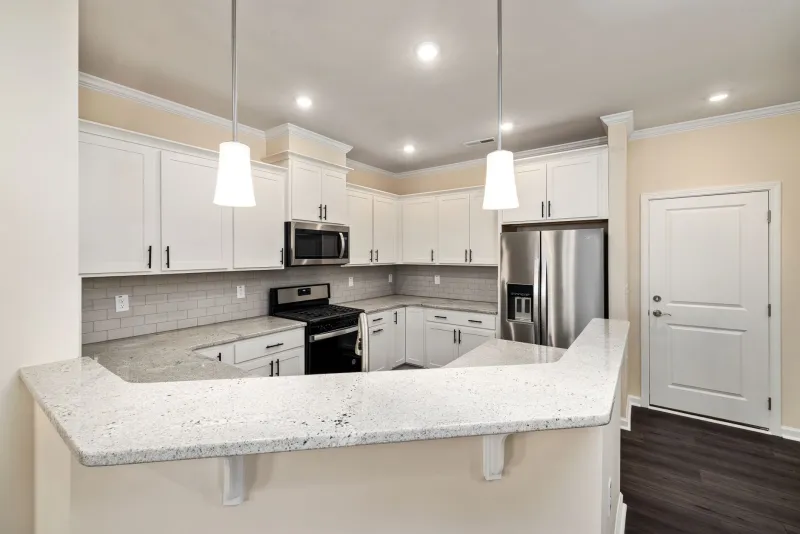
"We told ourselves it would be a countertop swap," one Weed Street homeowner recalled, requesting anonymity to protect what she described as "ongoing contractor relationships." "Eighteen months later, we had a new layout, custom cabinetry from a mill in Vermont, a quartzite island flown in from Brazil, and a sub-panel upgrade we didn't know we needed until week six."
Welcome to what locals have taken to calling, with varying degrees of affection, the New Canaan Kitchen Renovation Industrial Complex.
The Anatomy of Scope Creep
To understand why a countertop replacement becomes a multi-year project in this town, one must first appreciate the particular ecosystem in which these decisions are made. New Canaan is a community of high-achieving, detail-oriented residents who apply the same analytical rigor to selecting a backsplash tile as they might to a business acquisition. The result is a renovation culture defined by exhaustive research, iterative decision-making, and a baseline assumption that good enough is, in fact, not quite good enough.
The process typically begins with a visit to one of the design showrooms along the Post Road corridor or a recommendation passed along at a school pickup line. From there, the homeowner enters what contractors privately describe as "the consideration phase" — a period of weeks or months during which samples accumulate on kitchen islands, Pinterest boards multiply, and the original scope begins to quietly expand.
"The countertop leads to the cabinets," explained one local general contractor who has worked in New Canaan for over a decade. "The cabinets reveal that the lighting is wrong. The lighting exposes the flooring. The flooring makes the appliances look dated. And suddenly you're looking at a full gut renovation with a budget that would have been unrecognizable at the start."
This is not carelessness. It is, in its own way, a form of thoroughness.
The Contractor Ecosystem
New Canaan's renovation market operates according to its own internal logic. Skilled contractors here are not merely hired — they are cultivated. A good tile installer or a trusted cabinet maker is a social asset, shared between neighbors in hushed tones at the Waveny Park dog run or over coffee at Saxby's. Referrals carry the weight of personal endorsements, and the best tradespeople maintain waiting lists that can stretch well beyond a year.
This scarcity is not incidental. It is, in part, a product of the town's own standards. Contractors who work regularly in New Canaan understand that tolerances are tight and expectations are specific. A grout line that might pass without comment in another market will be photographed, measured, and discussed at length here. This dynamic produces excellent work, but it also produces timelines that bear little resemblance to the initial estimates.
"I've learned to add a contingency buffer before I even open my mouth," one kitchen designer based in Fairfield County admitted. "Not because the work takes longer, but because the decision-making does. Every selection gets reconsidered at least twice. That's just the culture."
The Social Dimension
No examination of New Canaan renovation culture would be complete without acknowledging the role that neighborly awareness plays in the process. This is a town where houses are noticed, where design choices are discussed, and where the finished kitchen of a neighbor can quietly reframe one's own sense of what is acceptable.
Residents are largely reluctant to frame it in competitive terms — and to be fair, the motivations driving most renovation decisions are genuinely personal. Still, there is an ambient awareness of prevailing standards that shapes individual choices in ways both subtle and significant.
"I don't think anyone is renovating to impress their neighbors," one longtime South Avenue resident offered carefully. "But I also don't think anyone is renovating in complete isolation from them."
The social infrastructure of the town reinforces this dynamic in unexpected ways. New Canaan hosts a robust calendar of home tours, charity events held in private residences, and the kind of informal dinner party circuit that places kitchens on regular public display. A space that might otherwise be considered purely functional becomes, under these conditions, something closer to a semi-public room.
The Design Perfectionism Factor
Beyond social context, there is something more individual at work: a genuine commitment to getting it right that runs deep in the town's character. New Canaan has a long history of architectural distinction — the legacy of the Harvard Five modernists who made the town a landmark of mid-century residential design continues to cast a long shadow — and that heritage has cultivated a community that takes its built environment seriously.
For many homeowners, the extended timeline of a renovation is not a source of frustration so much as a reflection of due diligence. The two years spent selecting a countertop material are two years spent ensuring that the decision will not require revisiting for another two decades.
"People here are making long-term investments," noted one interior designer who splits her practice between New Canaan and Greenwich. "They want to do it once and do it properly. That takes time. It takes iteration. It sometimes takes going back to the drawing board after you've already ordered the stone."
When the Dust Settles
For those who have navigated the full arc of a New Canaan kitchen renovation — from the initial crack or the casual observation that the cabinet hardware looks dated, through the contractor search, the design revisions, the material delays, and the final punch-list walk-through — the finished product tends to inspire a complicated mixture of pride and exhaustion.
Most report that it was worth it. Most also report that they would approach it differently next time.
"The kitchen is beautiful," the Weed Street homeowner said, pausing in a way that suggested the sentence was not quite finished. "We love it. We really do. But I will say — the crack was about this big." She held her thumb and forefinger perhaps a quarter inch apart. "Sometimes I think about that."
The countertop, for what it is worth, is flawless.