Speaking in Tongues: How New Canaan's Children Are Inventing a New American Voice
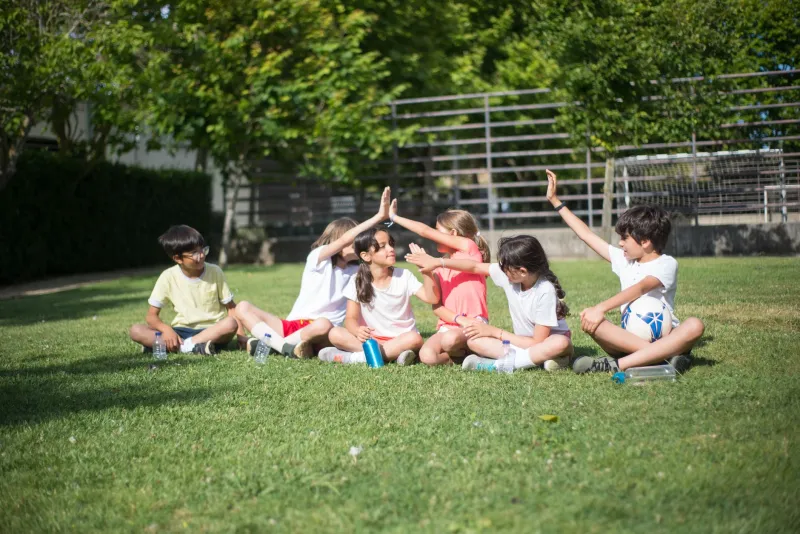
Listen closely the next time you find yourself at Waveny Park on a Saturday afternoon. The children racing across the grass, negotiating pickup games and debating which snack belongs to whom, are speaking a dialect their grandparents would struggle to place. It is not quite Southern. It is not quite New England. It carries traces of the internet, echoes of media consumed on screens large and small, and the particular cadence of a generation that has absorbed peers from Atlanta, Chicago, San Francisco, and Mumbai — often within the span of a single elementary school career.
This is the New Canaan accent, and it does not sound like Connecticut.
A Town in Constant Motion
New Canaan has never been a static community. Its proximity to New York City, the professional demands placed on the families who settle here, and the rotational nature of corporate relocation have long ensured a steady churn of arrivals and departures. Families come for the schools, the safety, and the quality of life. They stay for three years, or five, or sometimes twenty. They leave when the next assignment calls.
What that cycle produces, linguistically speaking, is a remarkable experiment in real time. Children who might otherwise absorb the speech patterns of their immediate geography — the flat vowels and dropped Rs that once defined Connecticut's Gold Coast — are instead surrounded by peers who arrived from somewhere else entirely. The regional template, if it ever truly existed in a town this transient, is continuously overwritten.
Dr. Rachel Sutton-Spence, a sociolinguist who has studied accent formation in mobile suburban communities, describes the dynamic plainly: "When children grow up in environments where no single regional accent dominates the peer group, they tend to converge toward a neutralized variety. They're not losing an accent so much as constructing a shared one."
In New Canaan, that shared accent is being constructed in real time, in carpools and cafeterias and on athletic fields where the team roster reads like a map of the American professional class.
What Accent Leveling Actually Sounds Like
The technical term — accent leveling — describes the process by which regional speech features erode when speakers from different backgrounds spend sustained time together. It is well documented in military communities, university towns, and international schools. It is less commonly examined in affluent American suburbs, where the phenomenon tends to go unnoticed precisely because it produces something that sounds, to most ears, like ordinary American English.
But ordinary American English is itself a construction, and what New Canaan's children are speaking carries its own distinctive markers. Parents who grew up in Connecticut — or in the Northeast more broadly — occasionally remark that their children sound like they were raised somewhere vaguely west of the Hudson. Vowels are slightly flatter. The pace is marginally more deliberate. Certain phrases arrive fully formed from TikTok or YouTube, carrying the cadence of a content creator rather than a neighbor.
One Elm Street School parent, who asked not to be identified by name, laughed when the subject came up. "My daughter came home one day using a phrase I had never heard in my life. I asked where she picked it up, and she looked at me like I had asked her to explain gravity. It just was how she talked."
That ease — the absence of self-consciousness about where language comes from — is itself a defining feature of this emerging dialect.
The Screen in the Room
No examination of how New Canaan's children speak can ignore the role of digital media. Unlike previous generations, who absorbed language primarily from family, teachers, and the immediate community, today's children are immersed in a continuous stream of content produced by creators who hail from every corner of the country and the world.
The implications are not trivial. Research from the University of Toronto and several American institutions has documented what some linguists call "media-influenced leveling" — the gradual adoption of speech patterns encountered through sustained screen exposure. For children already living in an environment where no single regional accent dominates, that media layer compounds the leveling effect considerably.
At New Canaan High School, the results are audible. Students who have lived in town since kindergarten speak in ways that their parents — many of whom arrived with strong regional accents intact — cannot entirely account for. The Connecticut Rs, the particular vowel elongations that mark old New England speech, are largely absent. In their place is something smoother, more portable, and in its own way, more cosmopolitan.
Identity Beyond Geography
What makes the New Canaan case particularly interesting to researchers is what it suggests about identity formation in communities where geography has been partially decoupled from belonging. In most American towns, accent functions as a badge — an audible declaration of where a person is from and, by extension, who they are. Children absorb that badge naturally, from family and neighbors and the accumulated speech of a place.
In New Canaan, that mechanism is disrupted. The town's identity is not primarily geographic. It is aspirational, institutional, and communal in ways that do not depend on sounding like a particular region. Children here belong to a school system, to sports programs, to social networks that span multiple states and, in some cases, multiple countries. Their accent reflects that belonging — a linguistic passport to a community defined less by place than by shared circumstance.
This is not, it should be noted, a uniquely New Canaan phenomenon. Similar patterns have been documented in communities from Westchester County to the suburbs of Houston to the planned developments outside Washington, D.C. But the degree to which New Canaan's transient, globally connected population accelerates the process makes it an unusually clear example of something happening quietly across affluent America.
What Parents Make of It
Reactions among New Canaan parents vary considerably. Some find the accent shift unremarkable — a natural consequence of the environment they chose when they moved here. Others express something closer to wistfulness, a sense that a regional inheritance has been quietly surrendered without anyone making a conscious decision.
"I grew up in Fairfield County," said one mother who has lived in New Canaan for eleven years. "My kids have no idea what that sounds like. They don't sound like Connecticut kids. I'm not sure they sound like anything in particular, and I suppose that's the point."
That ambivalence is worth sitting with. Language carries history. The flattening of regional speech is not merely an acoustic curiosity — it is a small but legible record of how communities change, who moves through them, and what survives the passage.
In New Canaan, what survives is something new: a voice shaped not by the land or its long history, but by the particular, restless, globally inflected present tense in which its children are growing up. Whether that voice constitutes a loss, a gain, or simply a fact depends entirely on who is doing the listening.