Platform 11 and the People Who Call It Home: The Hidden Social World of New Canaan's Daily Commute
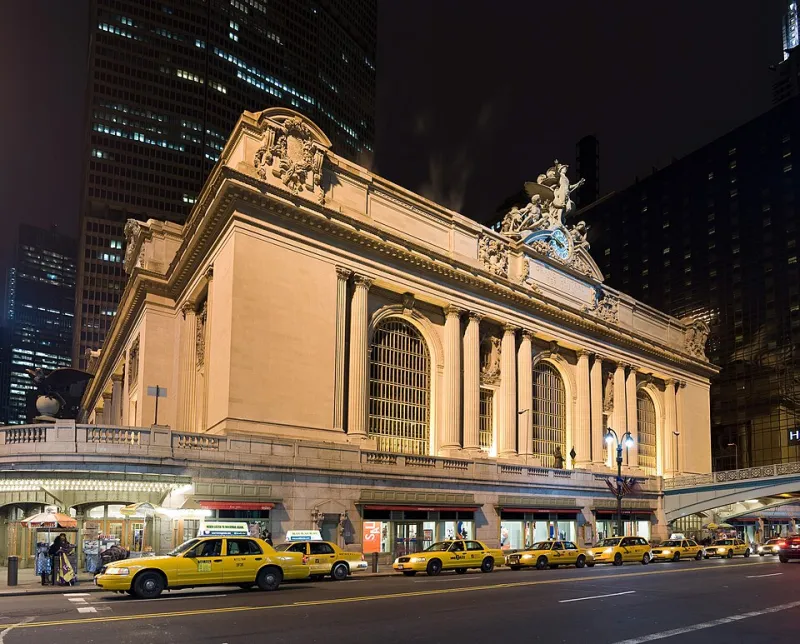
Photo: Fcb981 ; Eric Baetscher (attribution required), CC BY-SA 3.0, via Wikimedia Commons
The 7:04 out of New Canaan does not wait. Neither, it seems, does the cast of characters who have claimed it as their own.
For hundreds of residents who make the roughly sixty-minute journey into Manhattan each weekday, the Metro-North New Haven Line is not simply a means of transportation. It is, in its own understated way, a community—complete with unwritten rules, recurring personalities, informal hierarchies, and a social texture that most commuters would struggle to articulate but would immediately recognize if asked to describe it.
"You know who sits where," said one longtime New Canaan commuter who has ridden the 7:04 for nearly a decade. "Nobody assigns the seats. Nobody talks about it. But if someone new sits in the wrong car, you notice."
The Architecture of the Unspoken
Every regular commuter understands that the train is divided not by ticketed seating, but by something far more durable: habit. The quiet car attracts one type. The middle cars, where conversation flows freely and newspapers are folded and refolded, attract another. The rear car, closest to the New Canaan station stairs, tends to collect the punctual and the slightly harried—those who have calculated, down to the minute, exactly how late they can leave the house.
These micro-zones are self-reinforcing. Sit in the same seat for three weeks and it becomes yours in a way that no conductor will ever formally acknowledge but every fellow passenger intuitively respects. The social contract of the commuter car is enforced not through confrontation but through a kind of ambient pressure—the barely perceptible shift in atmosphere when a newcomer disrupts the established order.
What makes New Canaan's commuter culture particularly distinct is the relative compactness of its commuter base. Unlike the sprawling anonymity of a large suburban hub, the New Canaan station draws from a contained, cohesive town. The result is a degree of social overlap that amplifies the transit experience. The man across the aisle may also be your neighbor's employer. The woman who always reads hardcovers might be the parent of your child's closest friend. The commute, in this sense, is never entirely separate from the rest of New Canaan life—it is an extension of it, compressed into sixty minutes and a plush Metro-North seat.
Grand Central as a Third Place
If the train itself is the commute's spine, Grand Central Terminal is its beating heart. The terminal—cavernous, gilded, and perpetually in motion—functions for many New Canaan commuters as something sociologists might call a "third place": a space that is neither home nor office, but carries the social weight of both.
The lower-level dining concourse, the coffee kiosks along the Vanderbilt Avenue passage, the particular bench near Track 27 where a loose confederation of New Canaan regulars tends to congregate before the 5:52 departure—these are the landmarks of a geography that exists on no official map but is as real and navigable as any street in town.
"There are people I have spoken to almost every day for six years," reflected one commuter who works in finance and asked not to be named. "I know their kids' ages. I know when they changed jobs. I've seen them through divorces and promotions. And I have never once seen them outside of this building or that train."
This peculiar form of intimacy—deep in some respects, deliberately bounded in others—is one of the commute's defining social features. The relationships that form on platforms and in terminal corridors operate according to their own logic, one that does not necessarily translate to dinner invitations or weekend plans, but is nonetheless meaningful to those who inhabit it.
The Cast of Characters
Every regular commuter, if pressed, could produce a mental roster of the people who populate their daily transit experience. There is the man who has not missed the 6:48 in living memory and whose punctuality has become a kind of local legend. There is the woman who conducts entire conference calls at full volume between Stamford and Grand Central, to the barely concealed irritation of the quiet car's self-appointed monitors. There is the retired executive who still makes the journey twice a week, more out of ritual than necessity, because the train is where he thinks best.
These figures are known not by name, necessarily, but by presence—by the particular way they occupy their space in the commuter ecosystem. Their absence on a given morning registers in some peripheral, almost subconscious way. When the man who always reads the print edition of the Journal is not in his usual seat, something is slightly off about the morning, even if no one can immediately say why.
What the Commute Reveals
There is a sociological argument to be made that the daily transit ritual strips away certain professional pretensions in ways that the office never quite manages. On the train, the managing director and the mid-level analyst sit in identical seats, subject to the same delays, the same indifferent conductors, the same mediocre coffee from the café car. The leveling effect is not total—New Canaan's commuter culture carries its own subtle status markers, and the town's professional stratification does not simply evaporate at the station platform—but it is real.
"The train is one of the few places where nobody is performing," observed one resident who commutes to a law firm in Midtown. "Or maybe everyone is performing a little less. You're tired. You just want to get there. That makes people more themselves."
It is in that unguarded space that unexpected connections tend to form. Career advice exchanged over a delayed departure. A job lead passed along during the walk from Track 27 to Lexington Avenue. A friendship, genuine and durable, that began with nothing more than a shared complaint about signal delays outside of Stamford.
A Community in Transit
New Canaan has always prided itself on its sense of community—the block associations, the volunteer organizations, the dense web of civic and social ties that distinguish it from a mere collection of houses. What is less often acknowledged is that a meaningful strand of that community weaves its way through a train car each morning and evening, sustained by routine and proximity and the particular kind of trust that develops when people share a recurring experience over years.
The commute will not appear in any town planning document or community survey. It generates no tax revenue and occupies no municipal budget line. But for a significant portion of New Canaan's working population, it is as central to the rhythm of daily life as any institution the town formally celebrates.
The 5:52 boards in twelve minutes. The regulars already know where they're sitting.